Market Regime Classification
The first layer of Aerondight's scoring pipeline — detecting what kind of market we're in.
Markets don't behave the same way all the time. A momentum strategy that prints money in a tech rally will get destroyed in a crisis. The regime classifier exists to answer one question: what kind of market are we in right now?
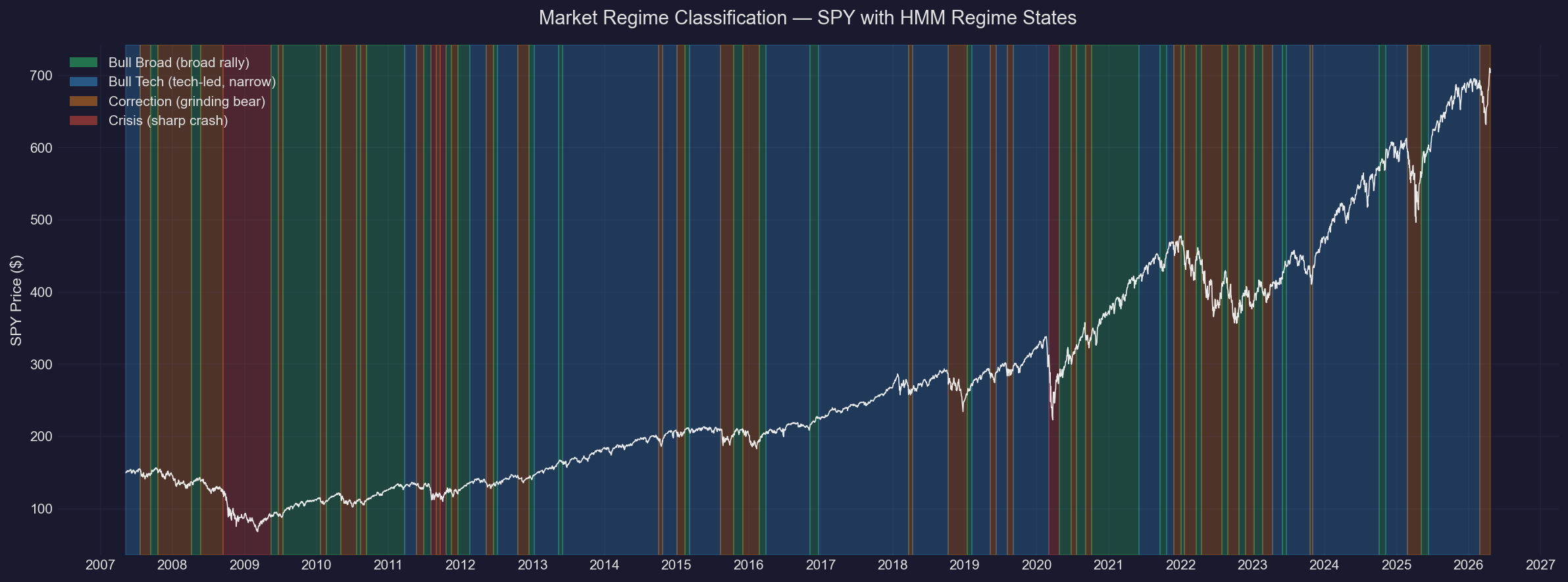
The Four Regimes
Bull Broad
The real economy is rallying with broad market participation. Cyclical sectors outperform, breadth is strong, and volatility is low. This is the classic risk-on environment where most stocks participate in the uptrend.
Bull Tech
A tech-led, narrow rally. Large-cap technology drives returns while breadth is weaker. VIX remains low, but leadership is concentrated. Momentum strategies work well, but the narrow base creates fragility.
Correction
A grinding bear market with elevated volatility (~24 VIX). Breadth deteriorates, spreads widen, and defensive sectors begin to outperform. This regime can persist for months and often precedes either recovery or deeper crisis.
Crisis
A sharp, violent crash with extreme volatility (~45 VIX). Rare (~6% of historical time) but devastating. Correlations spike toward 1.0. These episodes are short-lived but create the best long-term buying opportunities.
How It Works
The system uses two independent models for robust classification:
Hidden Markov Model
Learns the statistical properties of each regime from historical macro data. It identifies clusters of similar market behavior without being told what to look for. State labels are assigned automatically after training based on return and risk characteristics.
XGBoost Validator
Independently predicts the regime using a broader feature set. When both models agree, the system has higher confidence in the current classification. When they disagree, the system becomes more conservative.
Regime Timeline
SPY price history with color-coded regime backgrounds (smoothed):
Impact on Scoring
The regime classification feeds directly into the scoring engine. The same stock can receive different scores depending on the current regime. A defensive utility name might score higher in a correction than in a broad bull rally, even if its fundamentals haven't changed.
This is the key insight: context-aware scoring beats static scoring. The regime classifier provides that context.